
The Bread I Bake on SV Duende
My no-fuss boat-galley loaf, and why I had to kill my sourdough starter
This week’s post is a departure from sailing adventures, remote islands, and reports on our new location of Suva in Fiji.
I’m sharing a journey of a different kind, one that everyone can benefit from.
Bread is the foundation of goodness in the galley on SV Duende. I bake frequently, every few days, and I’ve adapted a method that fits our schedule, requires little equipment, and works in our onboard oven. My no-fuss recipe will work for anyone, whether you are sailing on a yacht, exploring by land in an RV or a van, or staying in an Airbnb or housesitting on a nomad journey.
I’m so happy to share my method here – complete with recipe and pictures.
But first, a story.
A few years ago, when we were in a boatyard in the desert grinding paint off the hull, it was very difficult to get good bread in our little Mexican town. Even when it looks artisanal, Mexican bread is usually just a variation of Bimbo, a close cousin of Wonder. IYKYK
So, I decided to start baking my own bread. I wasn’t a stranger to the idea – my mom was an amazing baker and every Saturday morning I helped her bake the bread that would last us through the week. As well as the cinnamon buns that wouldn’t last more than a few hours. My mom’s bread was wonderful, but her process was labor intensive, with kneading and rising and more kneading and proofing. I was interested in an easier method.
I discovered some “no-knead” bread recipes and decided that was for me. But they all advocated the use of heavy cast iron Dutch ovens, and very high baking temperatures to get the steam and “oven spring” needed for a good rise. The little casita we were living in while in the boat yard had a not-so-hot gas oven, and I’d traded all my heavy cast iron and enamel pots for lighter versions that are more suitable for onboard use.
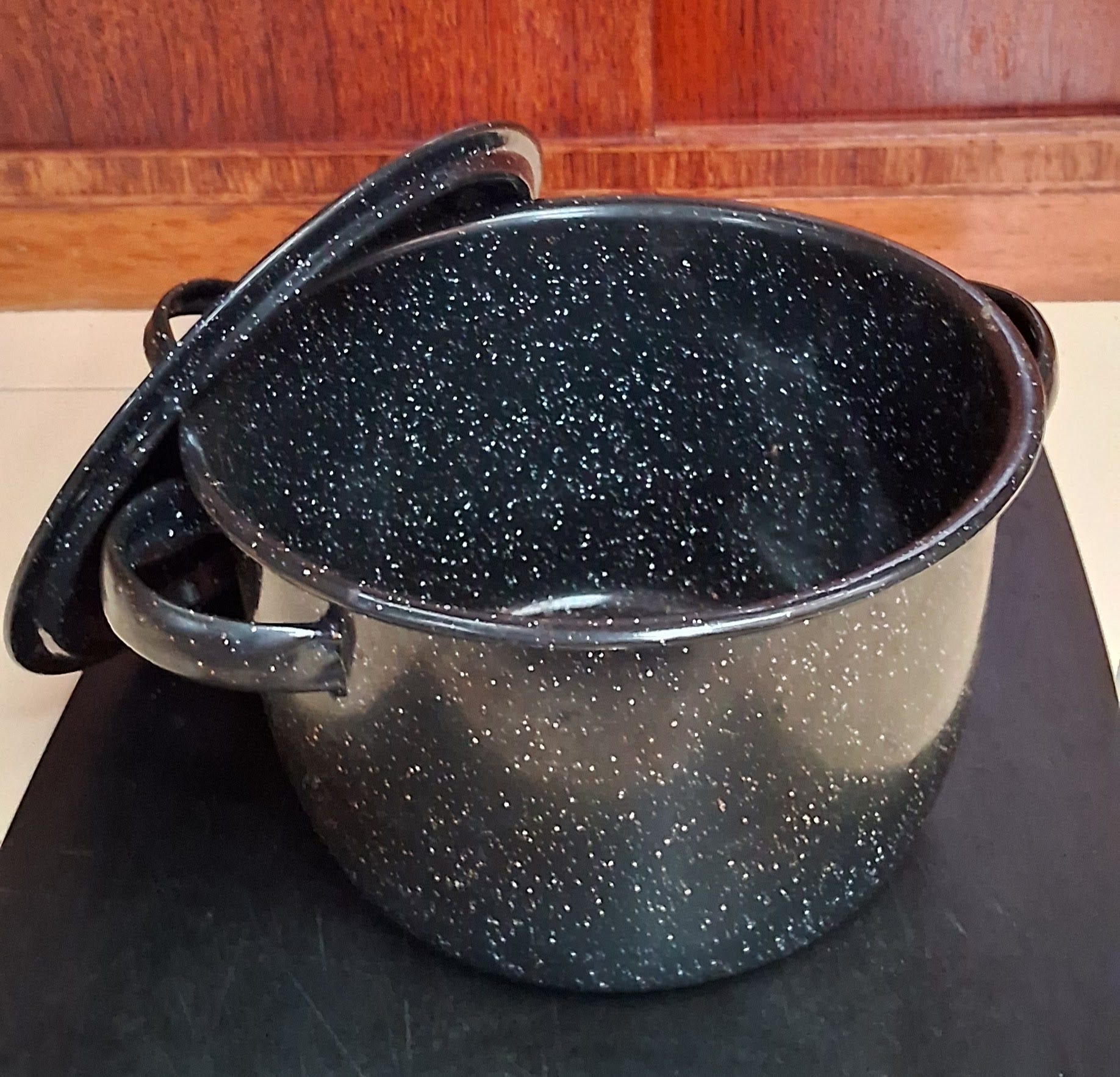
So, I improvised and experimented. It turned out that a cheap Graniteware pot that I bought at a street market worked just fine, and because it was thin and light, it didn’t require the “preheat” phase that all the no-knead recipes suggested. This was good in the casita and would also be good in Duende’s galley. It would use less propane, and I wouldn’t have to maneuver the loaf into a red-hot pot when underway in a rolling sea.
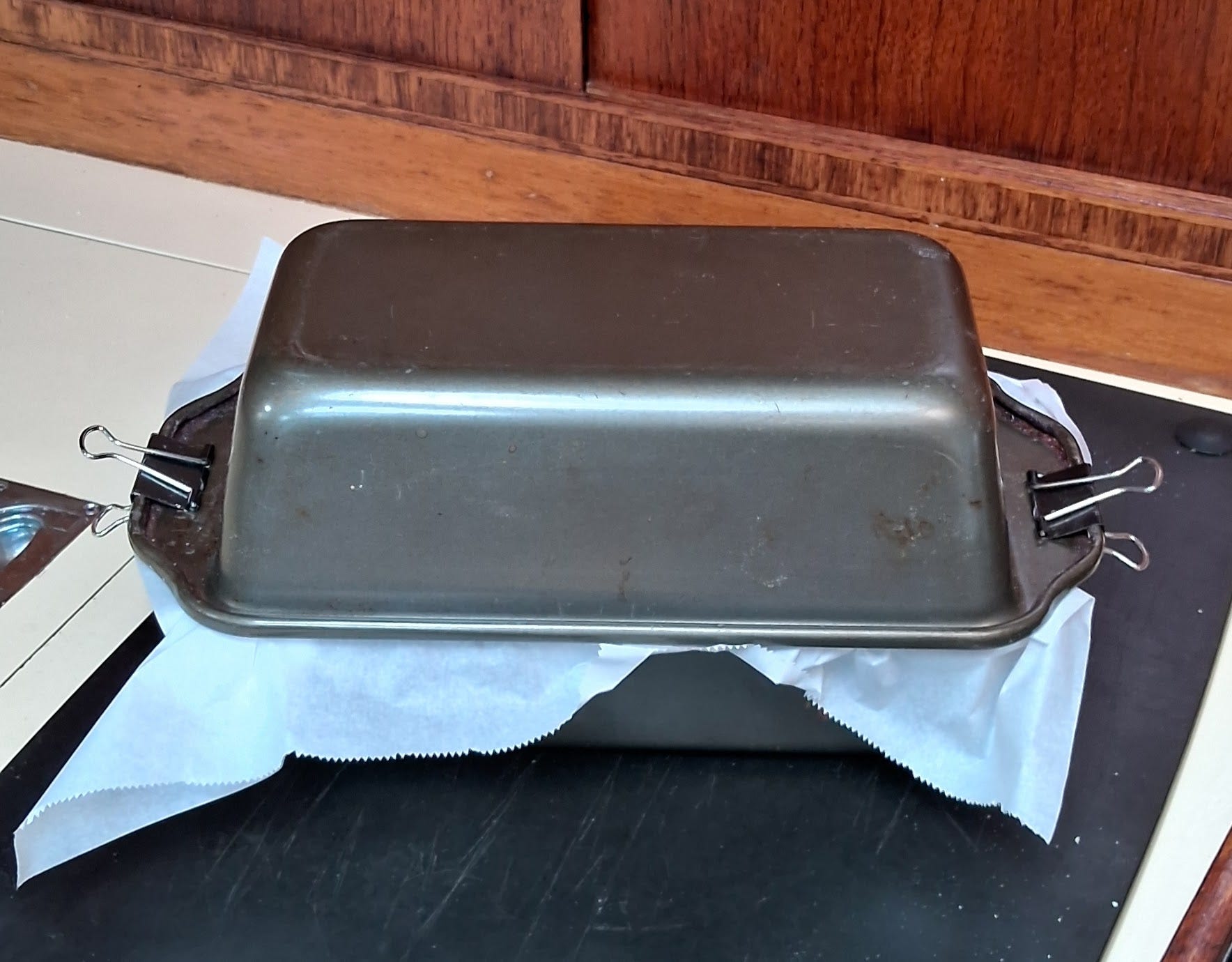
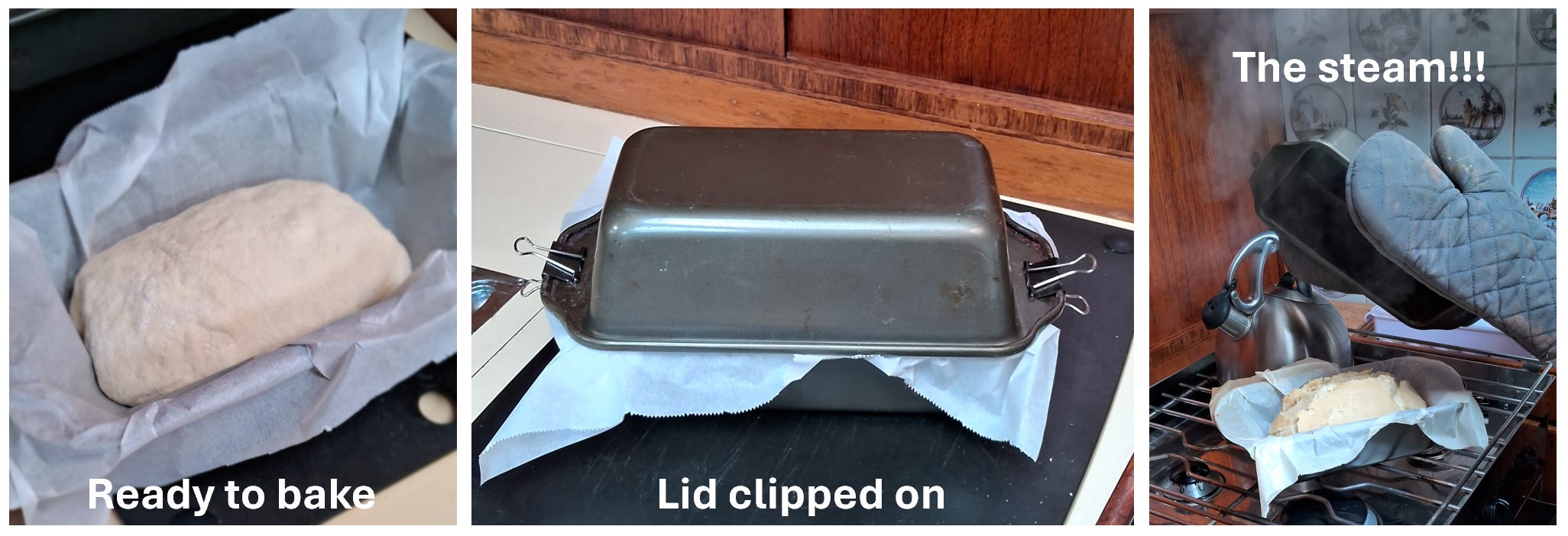
I’ve also since devised a new method for making a loaf shaped loaf, rather than a round loaf. I use two loaf pans and put one upside down over the other as a lid and clamp them together with bulldog clips. Works like a charm!
Then I discovered that it was even better to mix the dough up in the evening, let it rise overnight, and bake it first thing in the morning. This is especially good for boat life, as I can get the oven part over with before the heat of the day. And there’s nothing like the smell of fresh baked bread in the morning. It’s smile inducing and habit forming.
After the boat yard episode was over, and we were back in the water, it became part of my routine to keep fresh bread on hand. For the next year we were all so happy.
But then, I got distracted by the sourdough craze. Everyone was doing it – and it seemed so cool. I met people who were using starter that had originated a generation ago and was still going strong. That sounded amazing to me, and I decided to give it a try. I got a little jar of sourdough starter from my friend Don, another sailor. I named it Donnie in his honor.
At first it was so fun. It was like having a little pet on board. He was alive, and I was responsible for his care and feeding. I even took a piece of Donnie to my sister-in-law on a visit, and she started baking with his progeny, Sonny.
And oh, I tried so hard to make it work.
But Donnie was needy and temperamental and demanded an outsized amount of attention. It literally took 2 or even 3 days to bake a loaf of bread with all the feeding and stretching and folding and proofing. And no matter how much patting and praising I did, my results were far from consistent. The temperature and humidity levels were variable on board, and that added another challenge. Sometimes the starter would grow like crazy, sometimes it was just a watery gruel. My loaves would be light and airy with a perfect crumb one time, and tough and rubbery the next.
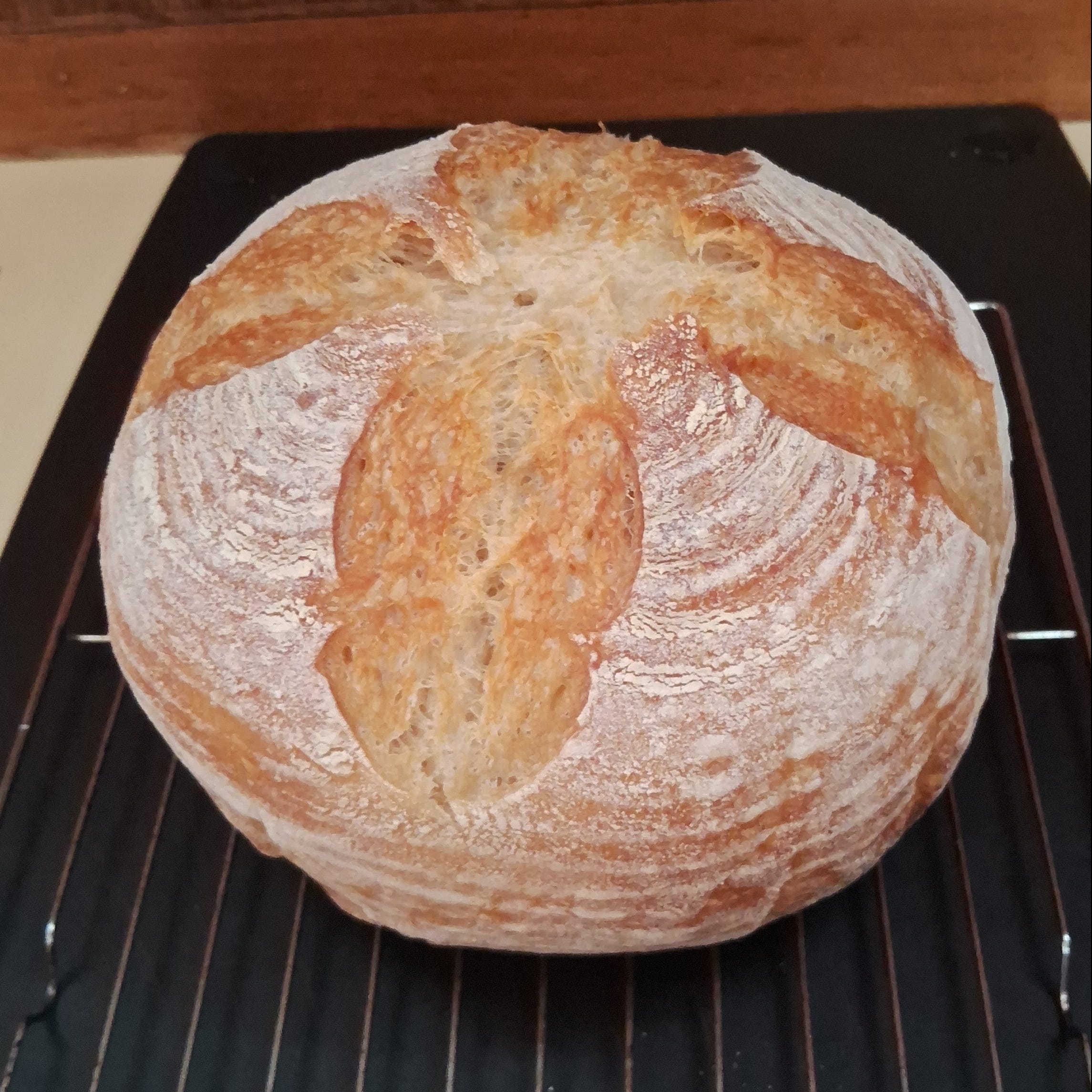
I bought a scale to be more precise in my measurements, I got scientific with water temperatures, I added rye flour to my feeding to give Donnie more nutrients. But my sourdough loaves were just not as good as my simple no-knead yeast bread and I felt like I was just wasting time and precious ingredients.
I finally reached a point where I couldn’t take it anymore. I was starting to resent Donnie and his demands. Something had to change, so I made a tough decision.
I killed Donnie.
As befits a member of the Duende crew, we gave him a burial at sea with an appropriate ceremony. It was a sad day, but deep down I was happy to see the back of him.
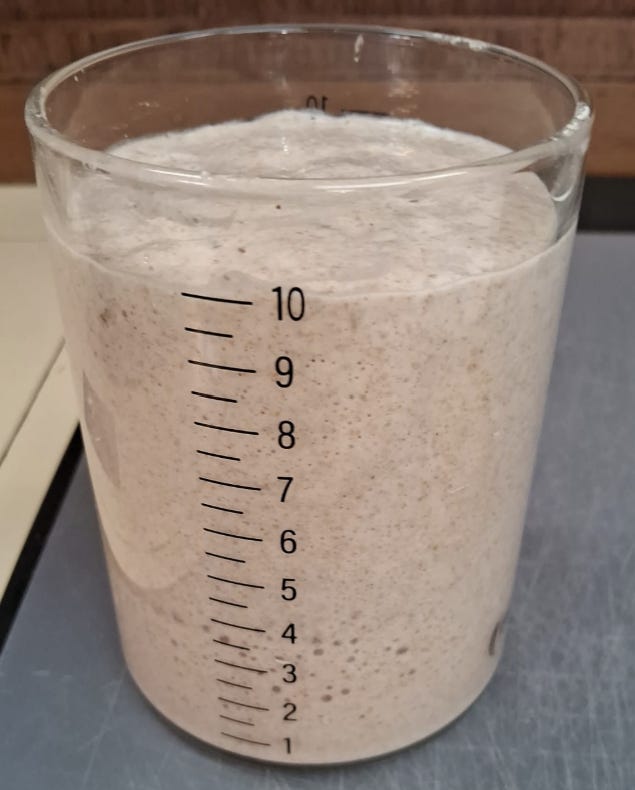
For the past two years, it’s been my simple, no-fuss, foolproof no-knead bread recipe that gives us our daily bread. Life is good. And there’s more good news – Sonny is still going strong, so Donnie’s lineage continues through his offspring.
Try it, you’ll love it. With this recipe you will experience the reward and satisfaction of making your own bread from scratch with only 4 ingredients - flour, yeast, salt, water. You don’t need fancy equipment and appliances. It’s easy, fun, and in today’s inflationary world – it’s economical. The last time I was in the US, bread from a good bakery was $8 dollars a loaf – or more. You can make this for a fraction of the price, save money, and totally impress your friends and family.
If you give it a go, please let me know how it turns out for you. And don’t hesitate to ask if you have any questions. I’m happy to help!
Sail on fearless crew! And enjoy the baking.
LJ
We are two people exploring the ocean on our 80-foot sailing yacht, without a full-time crew or a fat wallet. To all my constant readers, thank you for coming along on this voyage with us. It’s so much fun to share our adventures with you, and I hope you enjoy my stories. Please invite your friends and family to join us. All are welcome onboard SV Duende.
If you are new to the crew, you can see where this adventure started with the Duende Origin Story Part 1 (and 2, and 3, and 4).
Duende’s No-knead (No-stress) Bread Recipe
Ingredients:
3 cups of flour
1 teaspoon of active dry yeast
1 teaspoon of salt
~ 10 oz room temperature water (1.25 cups)
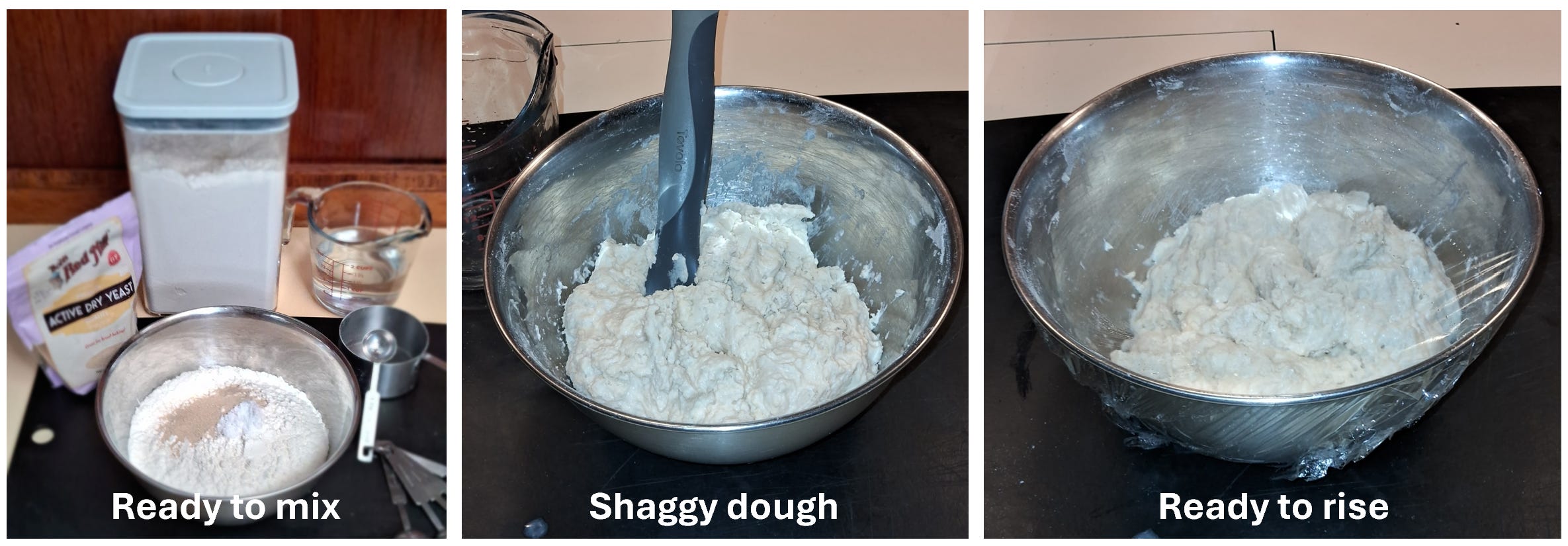
Method: (pictures ⬇️)
The evening before you bake, mix dry ingredients in a medium size bowl. Add water and mix to make a “shaggy” dough. It will be kind of loose, that’s what you want. (I’ve learned that different types of flour might require more or less water – you will learn what consistency to look for with practice – but dough that is a bit looser or stiffer will still yield a good loaf. Don’t worry.)
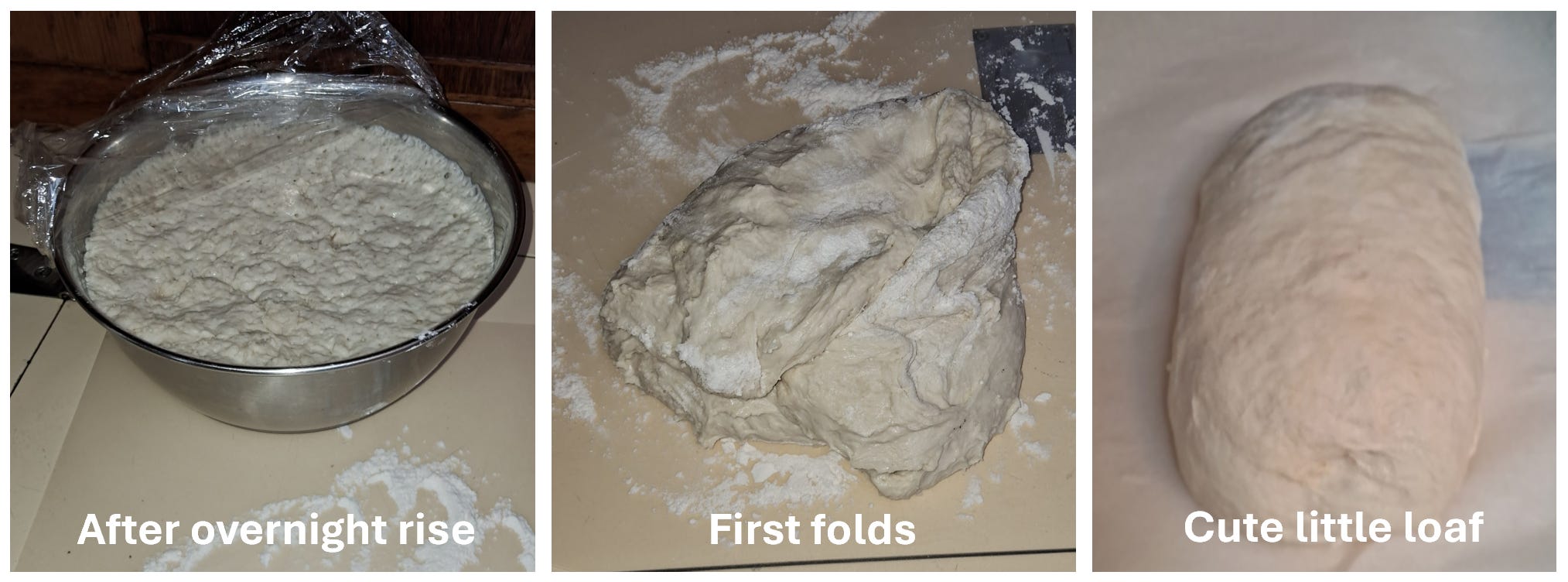
Cover with plastic wrap and let it sit overnight on the counter. I put mine in the microwave and shut the door to keep the temperature consistent, but I’ve also just let it sit out and it’s fine. (Remember, this is the no stress bread recipe, it’s forgiving.)
The next morning, preheat the oven to 400 degrees, or as close as you can get it if you’ve got one of those less-than-hot models.
While the oven is heating, turn the dough out onto a lightly floured surface. Fold the dough about 6 or 8 times. Press down slightly and turn it between folds. Shape the loaf – rounds or loaf shaped – depending on what pot you use. (I use a dough scraper to start the folds, and then finish shaping with my hands, stretching the surface a bit to create tension. This is the only tension in this recipe.)
Put the loaf on a sheet of parchment paper and drop it in the pot. Put the lid on. (If you use two loaf pans, secure the top pan to the bottom with bulldog clips – see pics.)
Bake with the lid on for 35 minutes.
Take the lid off and bake for another 30 minutes. (An amazing waft of steam will come out of the pot when you take off the lid – this creates your “oven spring” and helps the loaf rise while baking.)
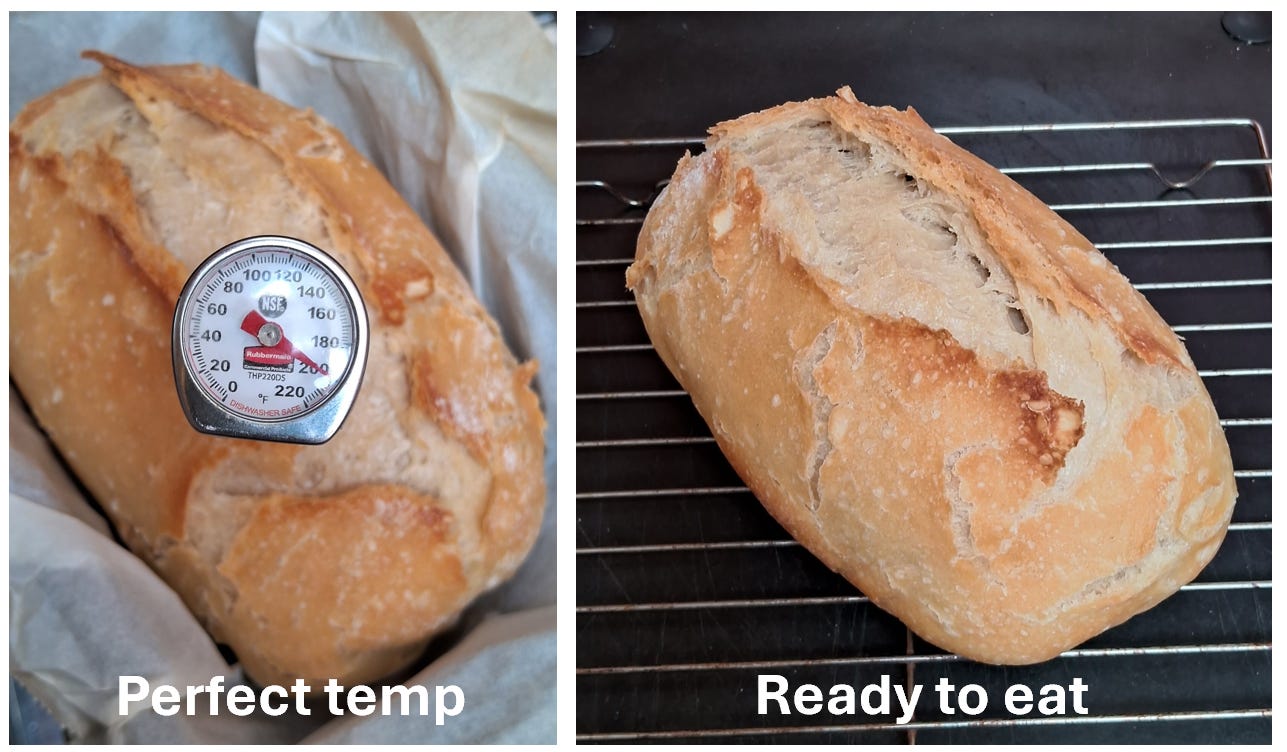
Let cool on a rack and ENJOY!!!! Bring on the butter, honey, or whatever you love best.
NOTES:
If your oven consistently holds 400 degrees, you can shorten the baking times to 30 minutes lid on, 20 minutes lid off. The loaf is done when the internal temperature reads 200 degrees on an instant read thermometer. Adjust times accordingly for your oven.
Sometimes I wrap the loaf in a kitchen towel for the cooling period for a softer crust. If you like it super crispy, don’t bother.
Mix it Up: This recipe is nothing but flexible. Here’s some variations I’ve had success with:
Different mixes of flour
half whole wheat, half white
2.5 cups of white with half a cup of rye flour
Additions (mix ½ cup of any of these into the dry ingredients before adding water)
sunflower, flax, pepita seeds, oats
pecans, walnuts
grated cheese - parmesan, cheddar, gruyere
chopped olives – kalamata or green
dried raisins, cranberries
Toppers
Before baking, brush the top with an egg white wash, and press on a layer of sesame or poppy seed, or everything bagel seasoning on top
Is there somewhere I can see a full tour of the boat? I'd love to see the entire layout.
Love home made bread!! Thanks for the Sourdough starter you brought to Mal, we've been enjoying fresh bread ever since