
How blue is the sky?
According to my measurement, it’s as blue as it can be.
Three of my favorite things are art, science, and color. Particularly, the color blue. As a full-time ocean dweller, it suits me well. So much of my day-to-day world is blue - from horizon to horizon - the ocean below and the sky above.
Often, looking up at the sky, I can’t help but wonder at its everchanging blueness – sometimes indescribably deep, dark shades, sometimes the palest of pale, barely blue at all. The ephemeral blueness is dependent on many factors – altitude, amount of humidity, amount of particulate matter in the atmosphere.
Recently, I read about the cyanometer, an invention from the late 18th century with which you can measure blueness. Specifically, the color of the sky. Clearly, I’m not the first to wonder about this.
Invented in the late 18th century by a Swiss scientist, Horace-Bénédict de Saussure, the cyanometer is a circular tool, dyed in gradations of blue with varying concentrations from white to dark. The original cyanometer had 53 swatches and was manually produced using Prussian Blue watercolor paint. It is designed to be used outdoors, by holding it up to the sky to determine which gradation is closest to the blue of the sky.
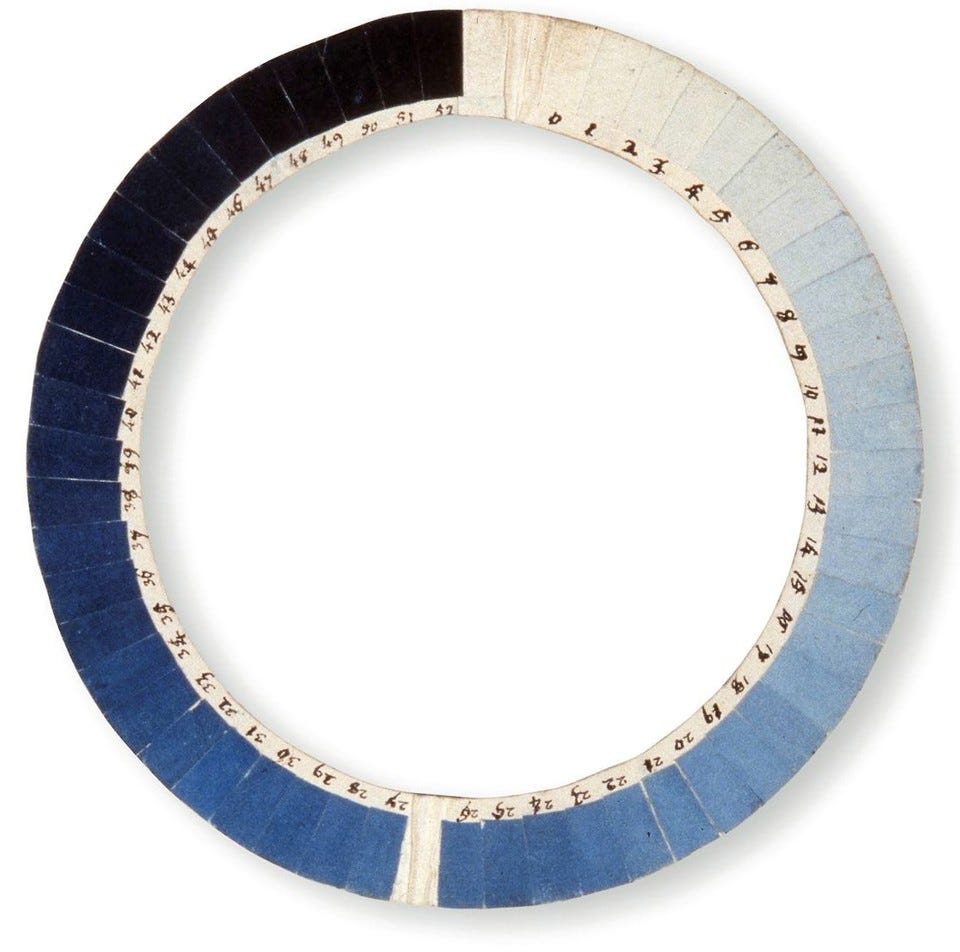
De Saussure and his naturalist friends used the cyanometer and its standarized method of testing to record observations about the color intensity of the sky.
The more I learned, the more I liked this idea.
While its roots are in science, there is a hand-crafted aspect to the cyanometer that I find irresistible. Mass producing exact replicas would have been near impossible for the original creators, and their “copies” would all have had their own unique characteristics. Anyone who has ever dabbled with watercolor knows that it’s far from an exact medium. Much depends on how concentrated the color is, how much you dilute the base color from gradation to gradation, even how much water is in your brush when you lay down the swatch. Those imperfections make this a very human creation, one that I had to try.
I made my own cyanometer to have some fun here on Duende.
Making the Pattern: The original cyanotype with 53 sections was complicated, so I followed the example of a simpler version with 24 sections. I drew an outer 8” diameter circle with a 3” hole in the center, divided the circles into quarters, then eighths, and then divided each eighth into three sections. This determined the size of the 24 wedges.
Choosing the Base Color: I searched through the blues in my watercolor paint box to find the closest match to my tropical skies here in the South Pacific. I decided to go with Cerulean Blue, as all the others seemed too dark, including the OG Prussian Blue used by de Saussure.
Painting the Swatches: I painted individual swatches starting with the fully concentrated color for #24 and steadily diluting it with drops from a water dropper as I worked my way down the scale to #1.
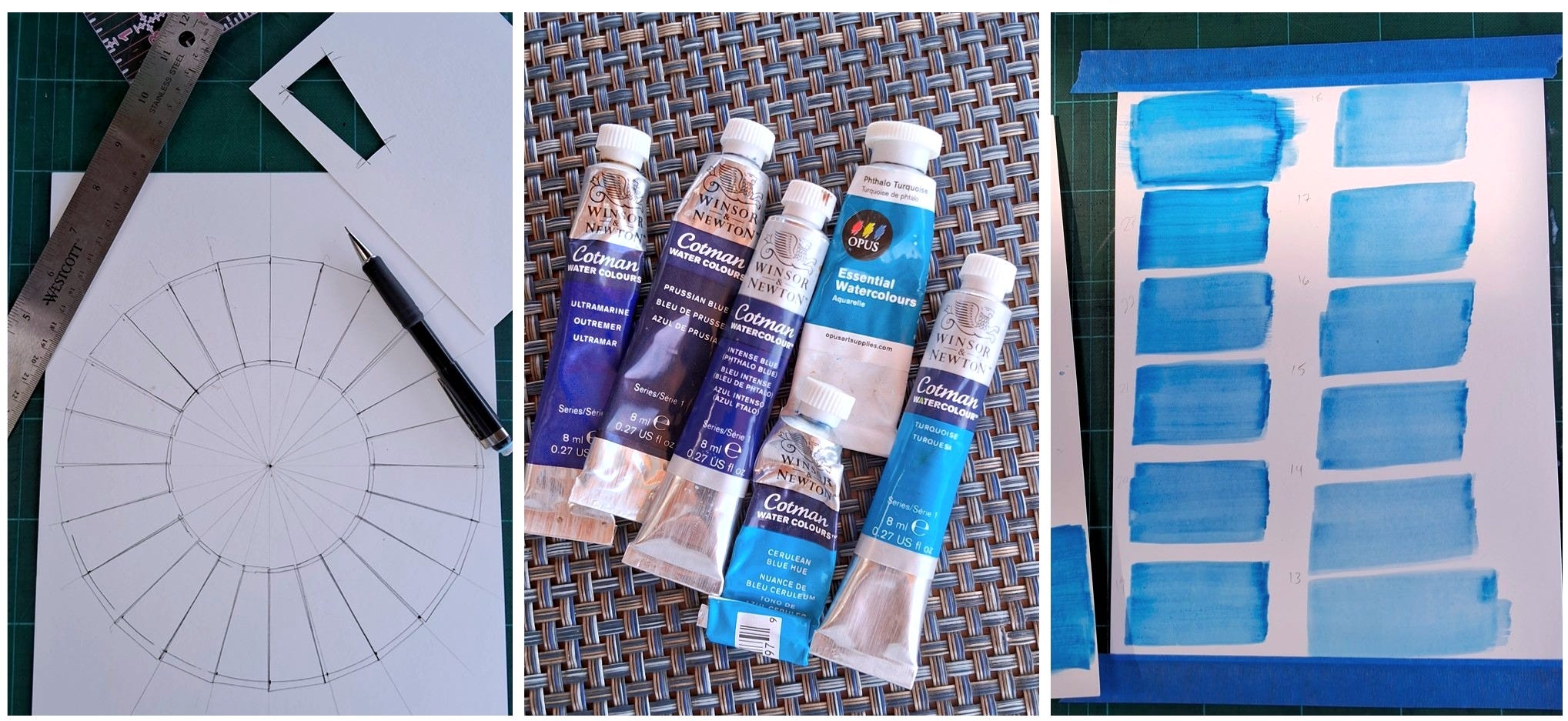
Cutting the Wedges: Using a stencil the I cut the wedges and positioned them on a draft page for a “fitting” before gluing them down on the final version.
Final Assembly: I recreated the circles on a clean sheet of paper, and starting with #1 wedge glued the wedges around the circle, doing a bit of trimming along the way to ensure the best fit.
Finishing: With all the wedges in place I trimmed off the outside around the 8” circle. I like the look of the flat ends on the wedges, so I kept them that way for a 24-gon shape. The last step was to cut out the inner 3” circle and add the numbers.
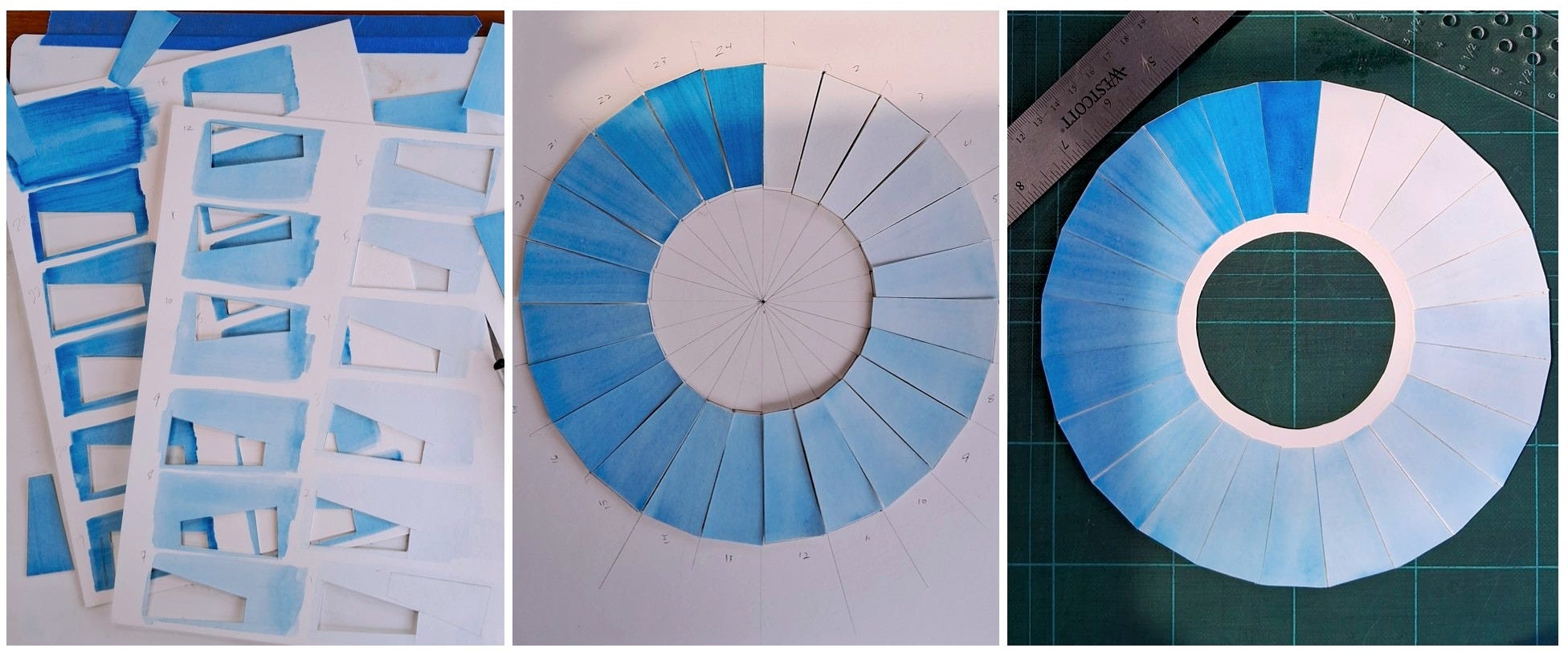
My finished cyanometer is so cool!
When I started on this project, working with my test strips and figuring out how to put it together, I wasn’t even sure that it was going to work. But the finished wheel is actually quite elegant, in a made-by-hand kind of way. It looks like a field instrument that could have been in the kit of an 18th century explorer – but it was made by me – crossing the South Pacific in 2026.
What color is the sky? Today, I’m giving it a solid 24.
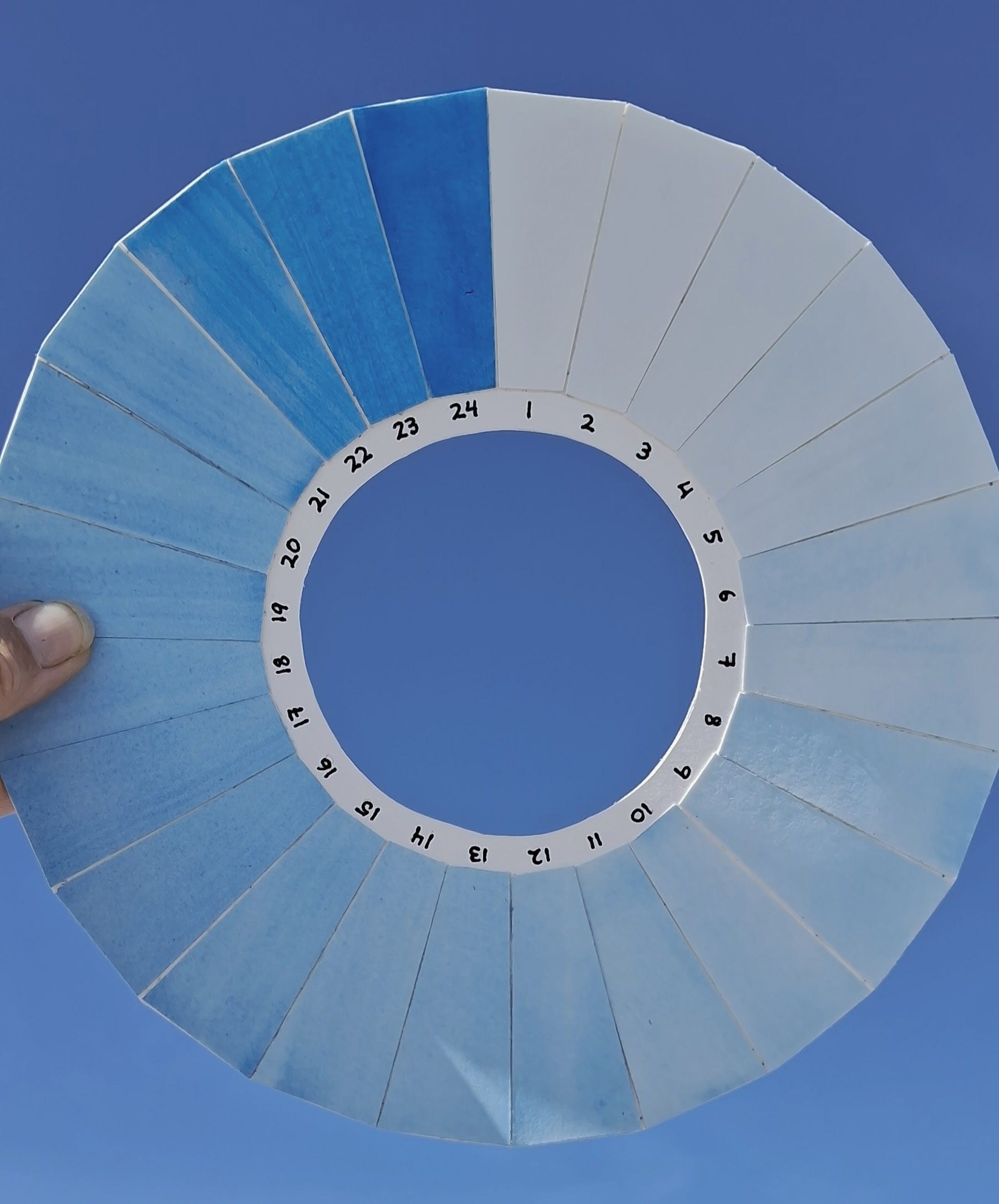
I have a feeling that this little hand-painted wheel will become part of the lore of Duende - a simple instrument that records not just the color of the sky, but the memory of where we were when I measured it. Every once in a while, I’ll channel my inner de Saussure and do some observations throughout the day of the color of the sky at zenith and at the horizon. It’s going to create some fun memories.
Sail on fearless crew! LJ

About Shellphone Chronicles
I write weekly essays that feature tall tales from the high seas, beautiful photos, original artwork, and occasional poetry. We are a crew of two, enjoying countless adventures on SV Duende, an 80-foot expedition sailing yacht on a multiyear ocean voyage.
To all my constant readers, thank you for coming along on this voyage with us. I love sharing our stories with you.
If you are new to the crew, welcome aboard! I’ve put together a Start Here page — a roadmap to guide you through some of our most popular essays and provide a few binge-worthy series suggestions. It’s a fun introduction to the themes that we weave through our life on the deep blue sea.

Meet Verde
Verde’s Very Lucky Day - A true story of an iguana and a little girl
is a beautifully illustrated eBook for all ages, children and adults alike. The story came out of a chance encounter with a little drowning iguana who showed me that one small act of kindness can make a big difference.
I saved his life and he changed mine.
Get your copy here with an automatic 15% discount. https://shellphonechronicles.gumroad.com/l/verde
Proceeds from the sale of the book will be donated to charity.
What a great idea to make one yourself! And what a beautiful one you made. I could use one of these for green and measure all the greens of Japanese trees.
I just love this. Absolutely perfect.