
Never in a Million Years Will AI Ever Make This
It’s real, and it can only be made by hand.
This post has been edited to include my Greek yogurt recipe and some pics of the process at the end. Enjoy!
Much angst has been caused lately from the pervasiveness of things not made by humans – from art, to writing, to all things creative.
Machines and the people that use them are taking pieces of our hearts and souls and calling them their own. But there are some things that machines will never be able to take from us – things that can only be made by human hands. Things that I love the most, like stitching, and painting, and of course, cooking.
On SV Duende, the galley is the heart of the ship. I make most of our food from scratch – not only because I often can’t buy prepared versions, but because I enjoy using my heart and my brain and my hands to make healthy and delicious food.
Cooking is one of my key creative outlets. I bake bread, cookies, cakes, and muffins. I make soups and stews and all my own sauces, dressings, and condiments. I make pizza, including the dough. Every day I plan a dinner that will yield leftovers to take us through lunch the next day – or maybe even a rerun for the next night’s dinner. We’ve lived the “whole food” diet for decades and enjoy knowing exactly what is in the food we eat.
Like Michael Pollan famously said, “Eat food. Not too much. Mostly plants.” This is how we love to live.
Right now, we are preparing for the next chapter in our ocean voyage, one that will take us further off the beaten track than we have ever been before. Some of the places we will visit in the next few months have little contact with the outside world and anything that doesn’t grow there arrives infrequently by ship. We will be able to buy basic foodstuffs – canned meat and fish, rice and beans. There will usually be a good selection of fresh veggies and fruits, and when we can we’ll eat fresh fish. But the kind of supplies I like to keep on hand for my creations are not going to be readily available, so I’m taking full advantage of my expert provisioning skills in our time here in Luganville on the island of Espiritu Santo in Vanuatu. I’m shopping like a fiend to top up our pantry cupboards and freezer with enough raw materials and ingredients to get us to the Solomon Islands and beyond.
There is one thing I know for sure I won’t be able to get. Good quality yogurt. Up until now, it’s been easy to buy good yogurt in the supermarkets. Now, in Vanuatu and our next ports of call, there is no dairy industry, and dairy products are not part of the native diet. Yogurt just isn’t available. This week, I was down to the last spoonfuls in my last container of yogurt that I brought from Fiji – a place that easily qualifies as yogurt heaven.
Yogurt is not a necessity, but something we enjoy and eat frequently. If there was ever a time to try to make my own, this was it.
I’ve heard from other sailors that it’s easy to make, but I must admit, I was a bit apprehensive. The idea of using a starter to grow something triggered some memories of my failure at sourdough bread. It’s too painful for me to rehash here, but if you are interested, you can read my essay about the long and messy culture war I waged and how I killed Donnie, my sourdough starter, and buried him at sea.
I also thought it required fresh milk. The milk I keep on board is UHT (ultra-high temperature), as it is shelf stable and can be stored unrefrigerated. I stock it by the case so I never have to worry about not having milk for my coffee and cereal. But UHT milk can’t be used to make yogurt, as the ultra-high temperature processing kills all the friendly bacteria and enzymes needed for fermentation. I thought we’d have to go without.
Then, I remembered that a sailor friend of mine in Fiji (who will probably read this essay – thank you Jim!) told me he makes yogurt using powdered whole milk, which is readily available here in all the islands. I was so happy to learn this, and I even had some on board, as I’d bought a couple of bags before we left Mexico last year. I dove in.
To my delight, I discovered that making yogurt is remarkably easy. You mix the milk powder with water, heat it on the stovetop, stir in a small amount of already cultured yogurt, and let it ferment in a warm place for 8 – 12 hours. After fermentation, you let it cool, and it’s ready to eat. At this point, you also put aside a couple of tablespoons to use as the starter for the next batch. I favor Greek style yogurt, so the final step is to strain it through cheesecloth for a few more hours. And voila! Amazingly thick and creamy yogurt.
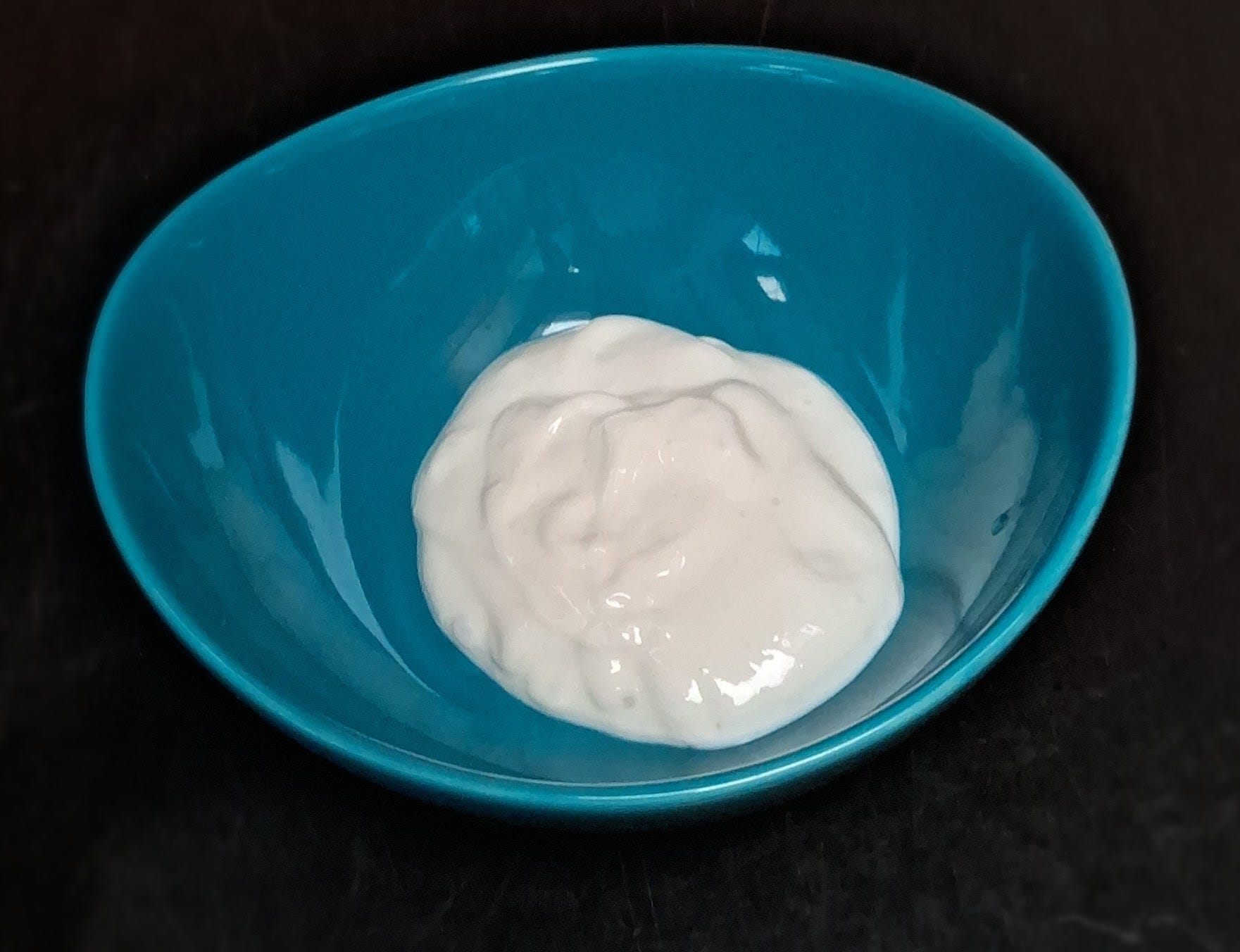
Bonus point – it’s so economical1. Extra bonus point - you can save the whey that is strained out to use in bread baking. I’m trying it tomorrow.
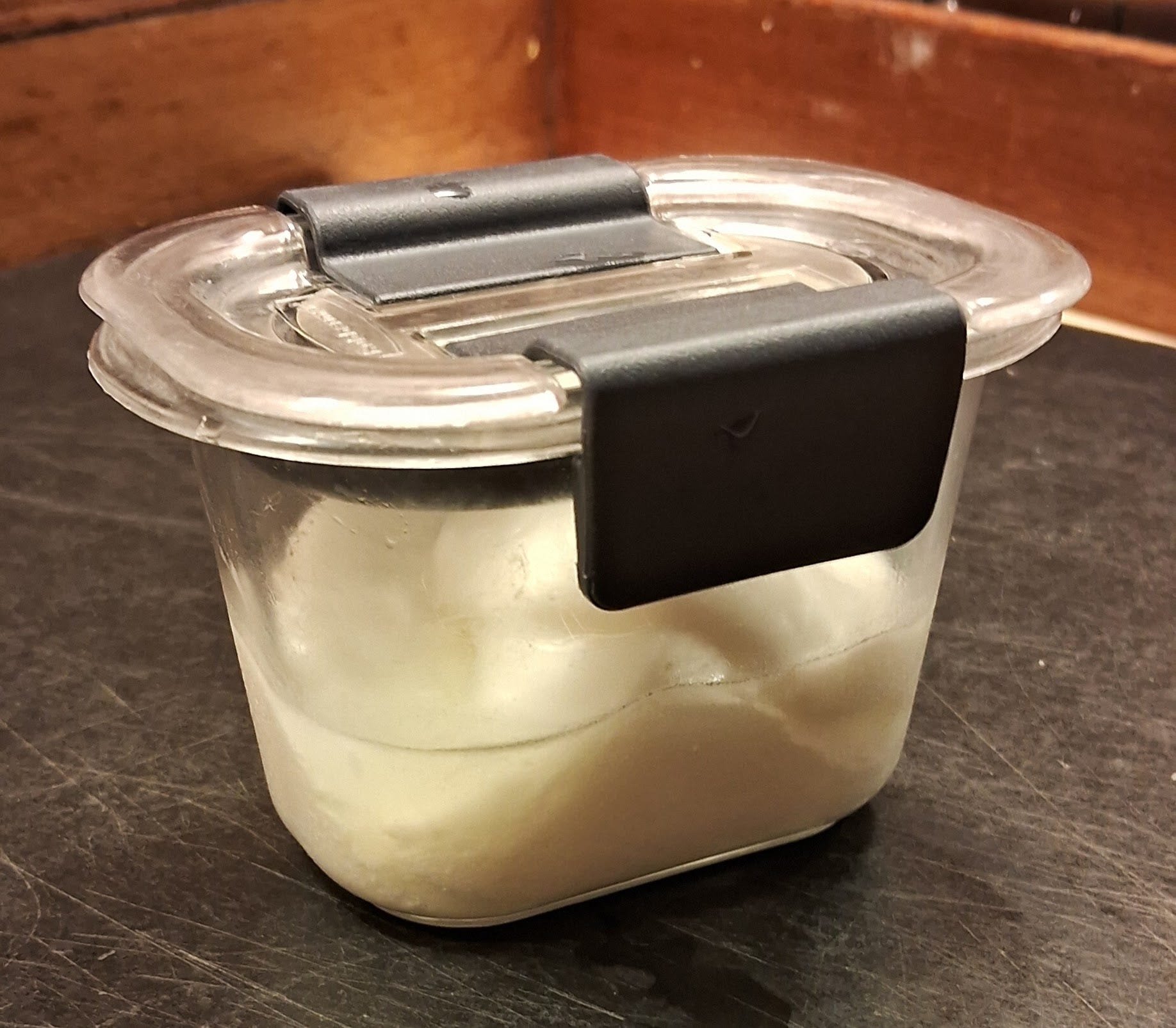
If I’d known it was this simple, I would have started making yogurt a long time ago. My new little starter friend, who I’ve decided to name Jimmy (yes, after my friend Jim) is happily ensconced in an airtight container at the bottom of the fridge, ready to go for the next batch.
And we’re enjoying our morning smoothies and overnight oats with my new, delicious, “I made this with my own hands” yogurt.
I’m proud to have another arrow in my culinary quiver – one that we’re sure to enjoy for years to come. I suspect that even when I can once again buy yogurt in a supermarket, I’ll continue to make it myself. Just because I can.
Sail on Fearless Crew! LJ

Greek Yogurt - Process and Pics
The basic process is simple - mix powdered milk with water, scald it to alter the proteins, cool it down, mix in the live culture, insulate it to ferment, cool it down, strain it to make it Greek. I may never buy yogurt again!
Here is the step-by-step guide to making this on a stovetop:
Ingredients and Tools
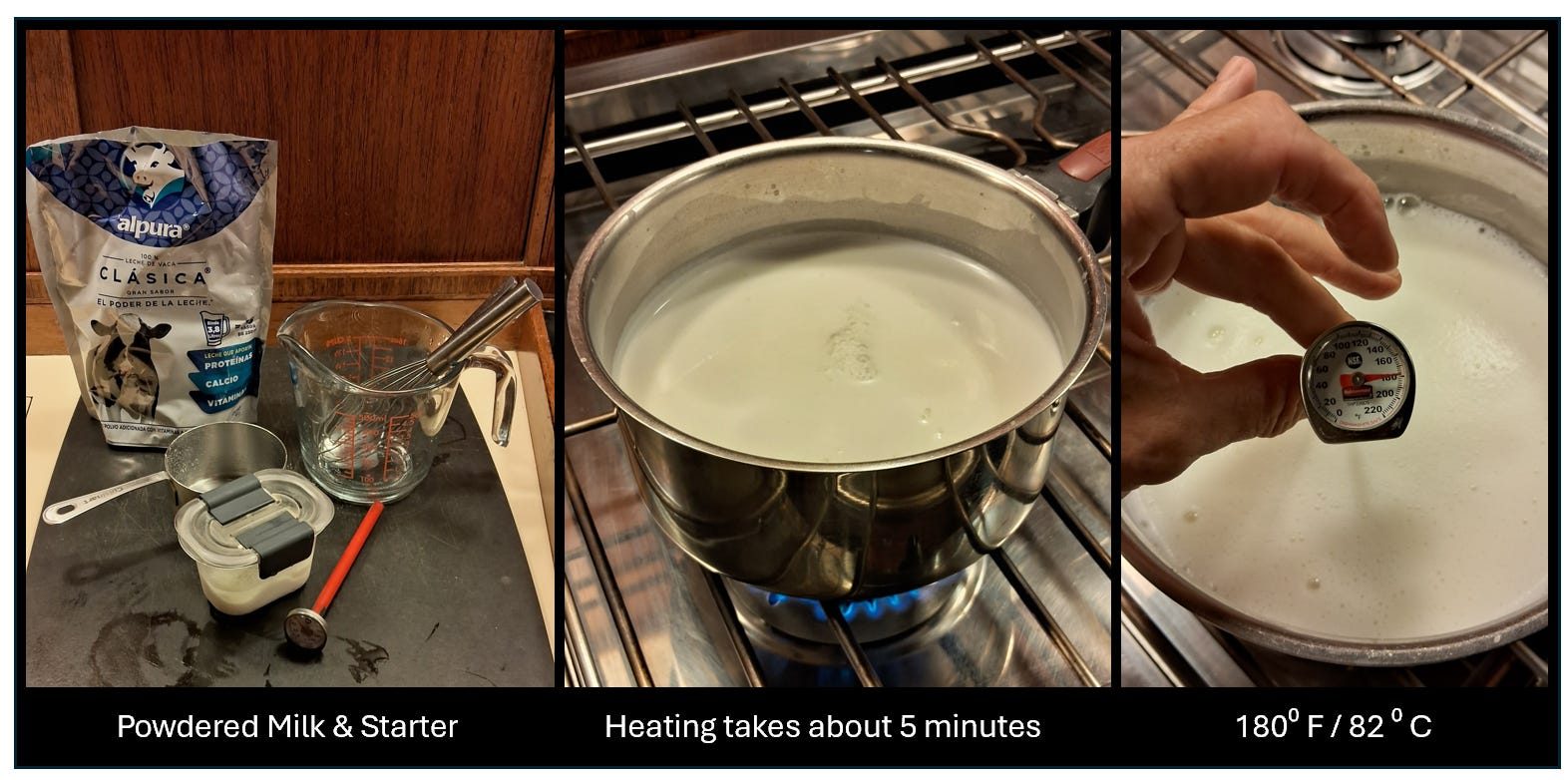
Whole milk powder: 1 1/3 cups
Water: 4 cups
Yogurt starter: 2 tablespoons of plain, unflavored, commercial yogurt. I used a natural brand of Greek yogurt, with “live and active cultures”
Tools: Heavy bottomed saucepan, whisk, kitchen thermometer (I use an instant read one), clean container with a lid, strainer and cheesecloth
Instructions
Reconstitute the milk - Pour 1 cup of water into the saucepan. Add the powdered milk and whisk until smooth. Add the rest of the water.
Scald the milk - Heat the milk over medium heat until it reaches 180⁰-195⁰ F (82⁰-90⁰ C)
Whisk constantly to keep it from scorching, don’t boil it.
Note: holding it at this temp for 10 minutes will create a firmer final yogurt - I didn’t bother with that part.
Cool the milk - Remove the pan from the heat and allow the milk to cool to 110⁰-115⁰ F (43⁰-46⁰ C)
Don’t skip this step - if you add your culture when it’s too hot it will kill the beneficial bacteria
Add the starter culture - Mix the two tablespoons of room temp starter with 1 cup of the warm milk and whisk until smooth. Add this back into the pot and stir to distribute the cultures evenly.
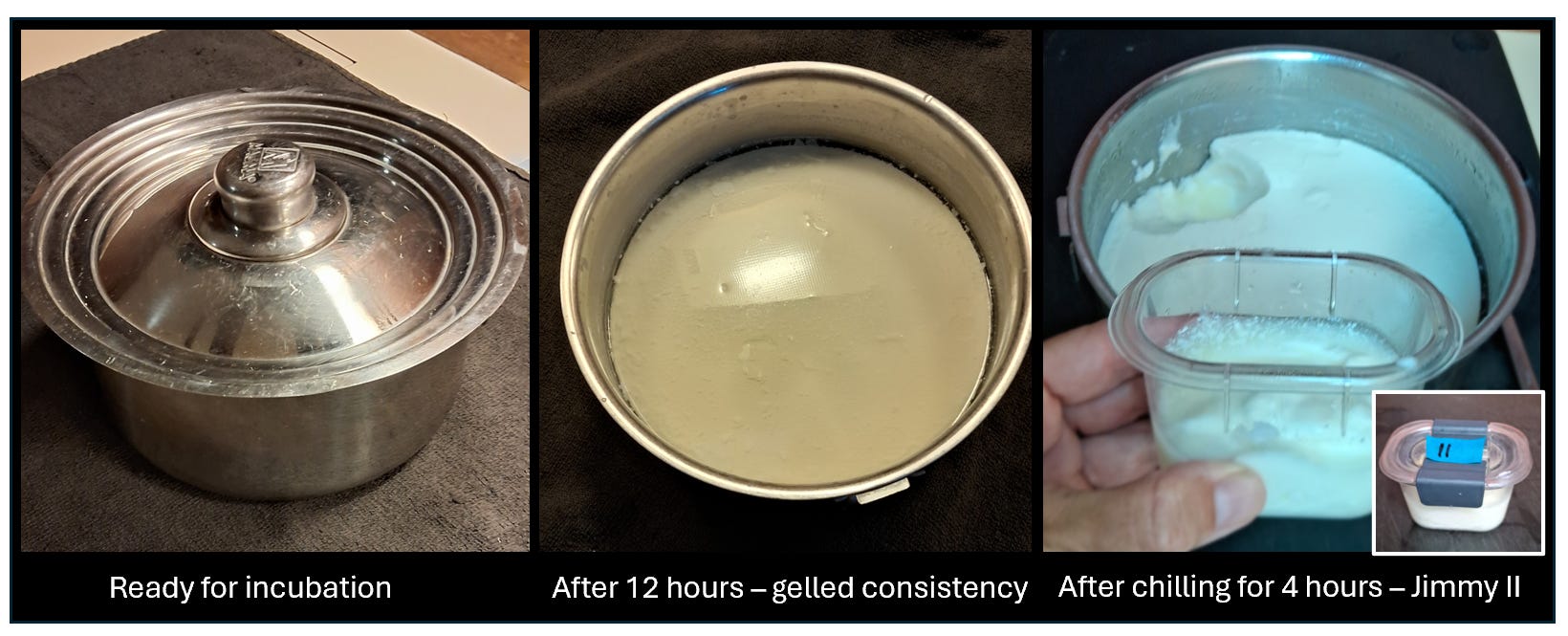
Incubate - I use the same pot for incubation, but you can transfer it to another container with a lid. Wrap the pot in a towel to retain the heat. I put mine in the microwave and prop the door open a tiny bit so the light stays on. This keeps it at the perfect temp for incubation. Let it sit, undisturbed, for 8 - 12 hours. I let it go overnight.
Chill and Set - After 8 - 12 hours, the consistency will be jiggly and jelly like. Put the container in the fridge for at least 4 hours to stop fermentation and firm it up. After this it’s ready to eat, but to make it Greek, continue with the next steps.
Save your starter - After chilling, remember to scoop out 2 - 3 tablespoons of the fresh batch and save it in a small, airtight container as the starter culture for your next round.
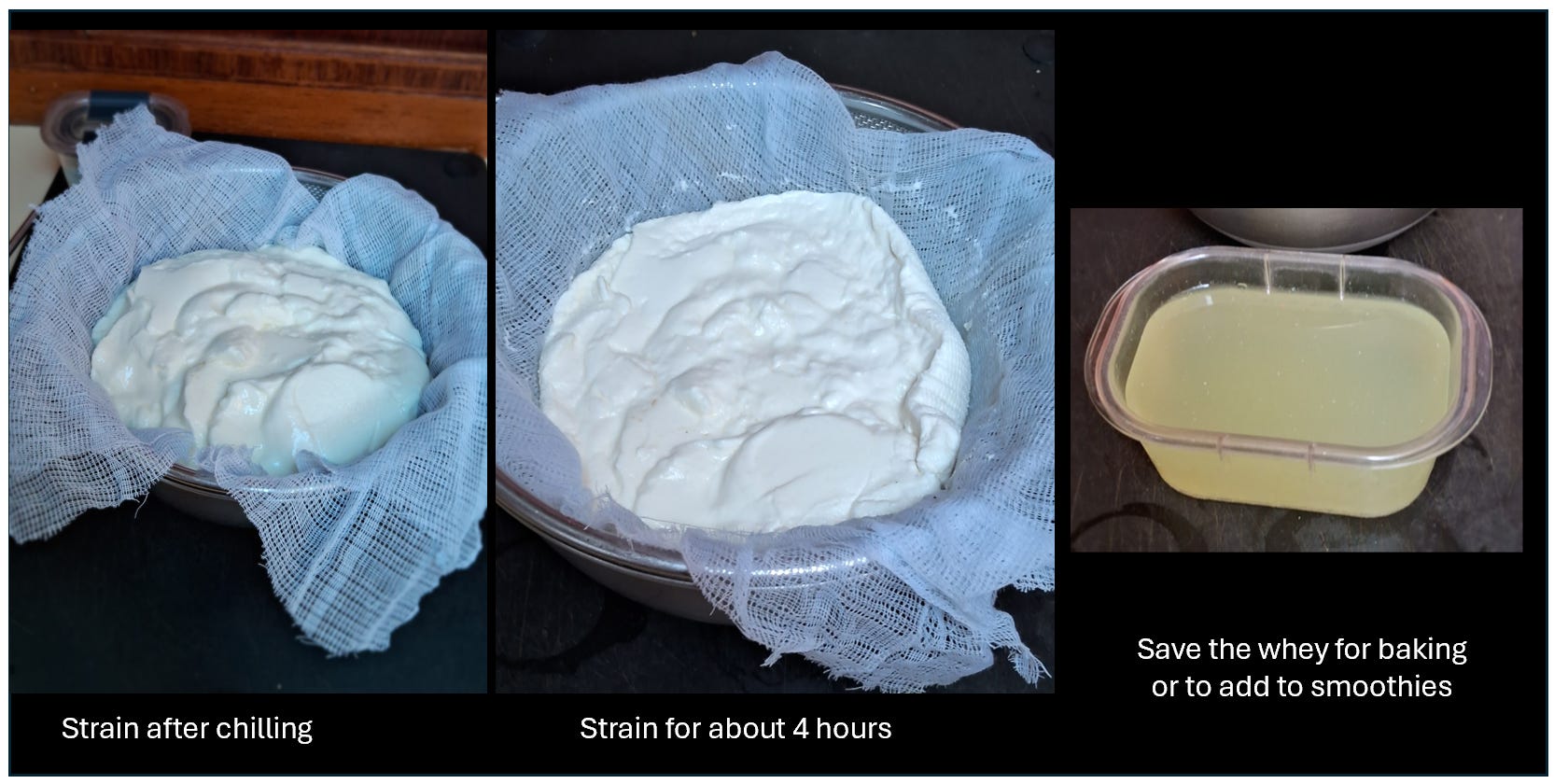
Note: this should be used within 7 - 10 days, as it will weaken over time. I’ve not gotten this far yet, but it’s said that after 3 or 4 generations you will need to refresh with a new bit of commercial yogurt. We’ll see… I’m saving Jimmy II now, and we’ll see how far he takes me - hopefully as far as the next place I can buy Greek yogurt!Make it Greek - Put a colander or strainer inside a large bowl - make sure there is space between the bottom of the strainer and the bottom of the bowl. Line it with cheesecloth, and scoop the yogurt into it. Put it in the fridge to strain. The liquid whey will drain into the bowl under the strainer.
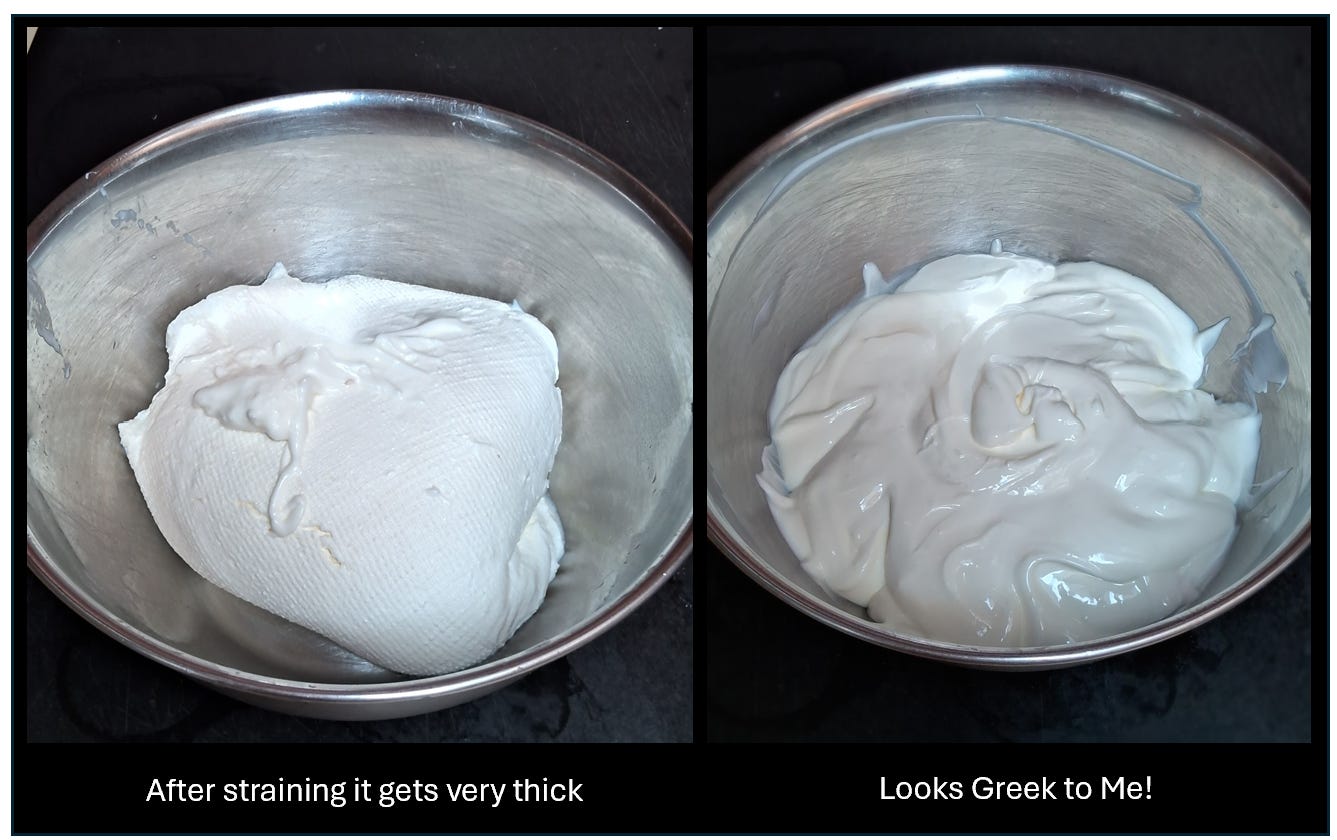
It will start to thicken after about an hour. I leave mine for about 3 hours, as I like it extra thick and creamy. If you left it overnight it would be almost like cream cheese (Labneh).Once it reaches your desired thickness, whisk it to make it glossy and pro looking.
ENJOY! Your homemade Greek yogurt will keep for a week or so in the fridge, but it’s likely it won’t last that long - mine doesn’t!
Whey can be kept for use in baking (I use mine in my bread) or as a great addition to a smoothie.

About Shellphone Chronicles
I write weekly essays that feature tall tales from the high seas, beautiful photos, original artwork, and occasional poetry. We are a crew of two, enjoying countless adventures on SV Duende, an 80-foot expedition sailing yacht on a multiyear ocean voyage.
To all my constant readers, thank you for coming along on this voyage with us. I love sharing our stories with you.
If you are new to the crew, welcome aboard! I’ve put together a Start Here page — a roadmap to guide you through some of our most popular essays and provide a few binge-worthy series suggestions. It’s a fun introduction to the themes that we weave through our life on the deep blue sea.
The math: 500-grams of Whole Foods Brand 365 Whole Milk Greek Style Yogurt is ~$4.00 USD. The same amount of my homemade yogurt is ~$2.00 USD. I’ll take a 50% saving any day!
I'm proud of you, too, Linda! I always thought it was tough to make yogurt. In my back to the land days friends would make it, and I'd always be in awe. Well, good going! And your starter looks great!
I also have a starter more like dried yeast that can be utilized for yogurt. I'm such a cheese freak that I carry those starters as well. Admittedly, I haven't made my own since I had access to fresh whole milk in Colorado; now bags of dried milk are at the ready. What fun. It's not new, it's rediscovering the basics. Happy packing! J